The Weight of Life - Art at AIDS Conference 26
At AIDS 2026 in Rio de Janeiro, the funding cuts took the headlines. In the Global Village, something else was already under way.
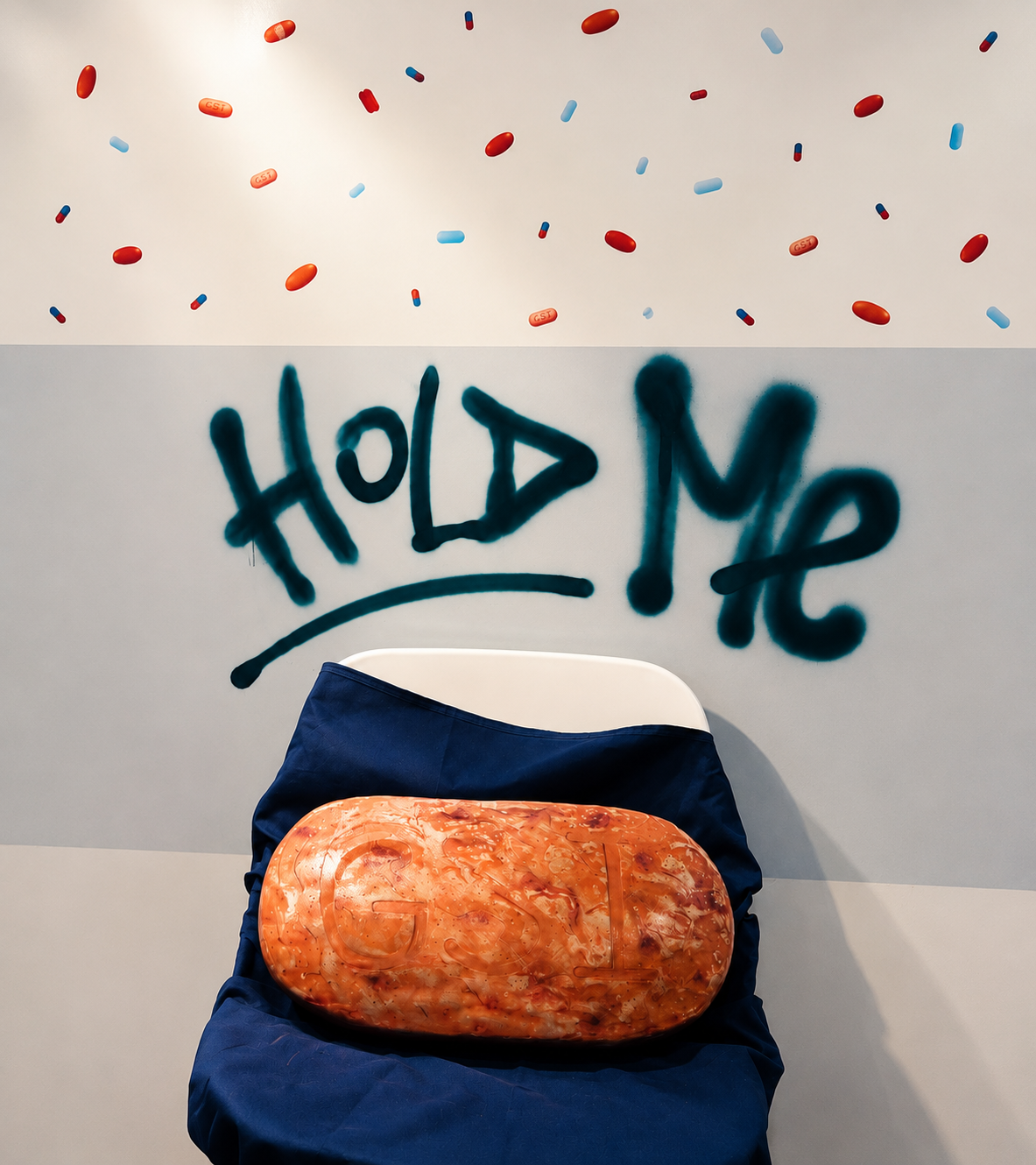
O Peso da Vida, The Weight of Life, by Matías Muñoz and Franco Miguens
There is a sign spray-painted on the wall in green: HOLD ME. Below it, on a draped chair, sits an oversized pill cast in epoxy resin. So you pick it up. It weighs eight kilograms, and it pulls your hands down before you can brace for it.
The piece is called O Peso da Vida, The Weight of Life, by Matías Muñoz and Franco Miguens. Eight kilograms is roughly the amount of antiretroviral medication a person takes over thirteen years of daily treatment. The panel beside it says that weight is not only accumulated milligrams. It is the weight of a diagnosis, of continual medical checkups, of bureaucracy, of stigma and fear; but also of resistance, awareness and hope. Then it asks a bold question: how much does a single life weigh when a daily pill is the condition for staying alive?
I came to Rio for the 26th International AIDS Conference expecting to write about money. It is the first edition since the funding cuts, and the figures are stark. UNAIDS launched its special report, United to End AIDS, on the opening day. Global development assistance fell by 23% in 2025, the sharpest drop on record, and around 9 million people living with HIV are still not on treatment. “We are no longer facing a future funding crisis,” Winnie Byanyima, the executive director of UNAIDS, told the opening press conference. “We are living through one now.”
That is the story most of the media will cover, and rightly so. But it was not what stayed with me. Because while the official program worked through the impact of the shortfall, on the other side of the conference hall a different response was under way. And it was the one that seemed most likely to shift the conversation.
Three conferences in one
It almost felt like there were three conferences running in parallel. The official sessions. The exhibition space, where the pharmaceutical companies had built their stands. And the Global Village, the only one of the three open to anyone who walked in.
The village is a maze of creativity. There is a booth by Claudia Langenegger, papered floor to ceiling in hand-lettered speech bubbles reading You’re not alone, in half a dozen colors, with cut-outs scattered across the floor. Beside it, a wall of handwritten notes under the question What’s your story with HIV? HIV is an isolating condition, and the piece’s simple message works like an outstretched hand to those affected.
Then a wall of unframed paintings by Ismail Senyonga. One, titled The Space Between Us, shows a gloved hand dangling a syringe while a bare one reaches for it. The cure, or a vaccine, kept just out of reach by the banknote hanging above.
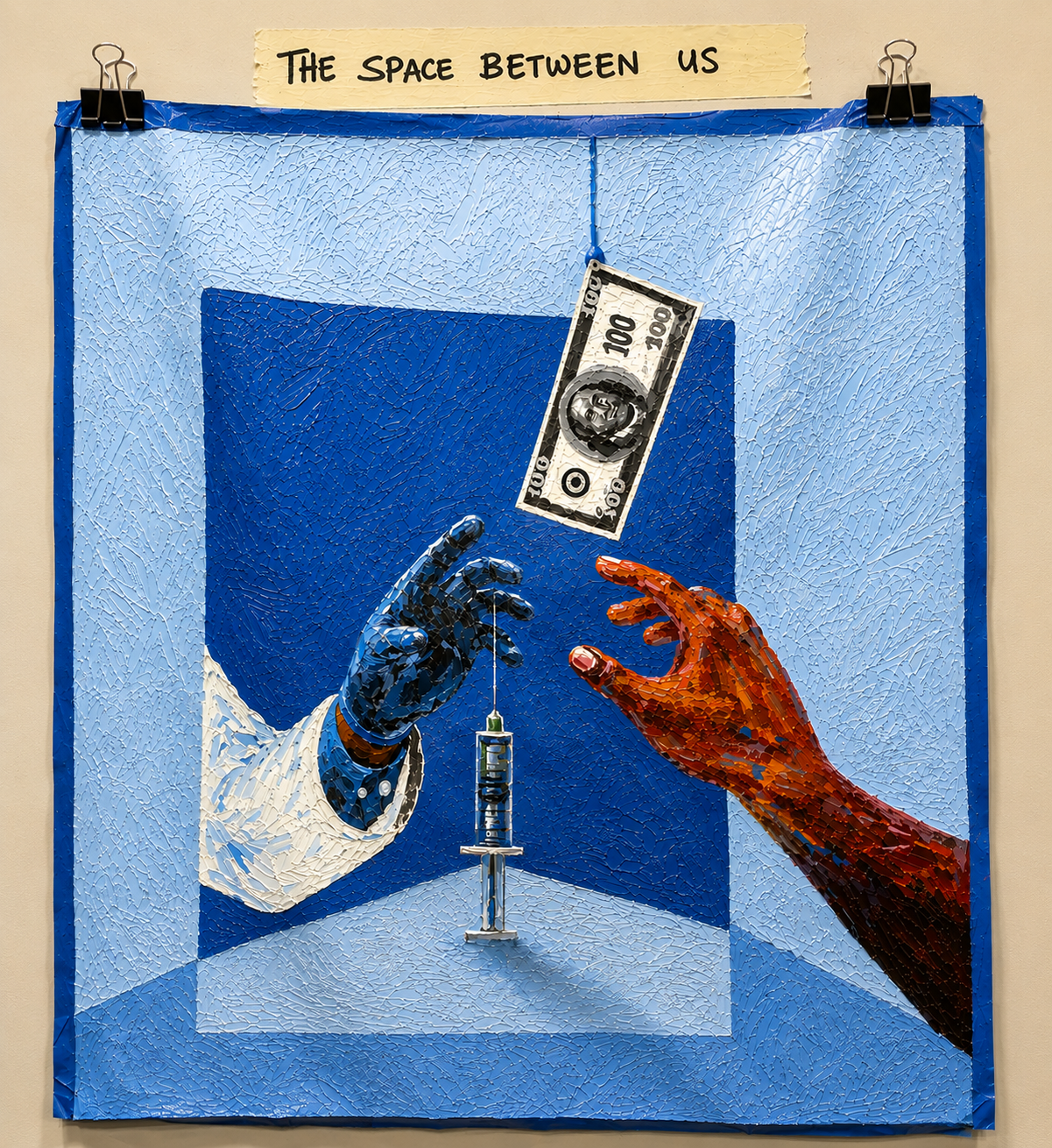
The Space Between Us by Ismail Senyonga
Next door, photographs by Victor Bebiano of street performances he staged this year in the streets of São Paulo, including a body entirely covered in red feathers. The series is called VERMELHO (RED), red for the virus, he writes, but also for blood, love and desire. It sits alongside a panel asking what we truly see when we look at another person and what we continue to see if that image is shaped by fear. If science can make the virus undetectable, it says, perhaps art can finally make stigma visible and help bring about its end.
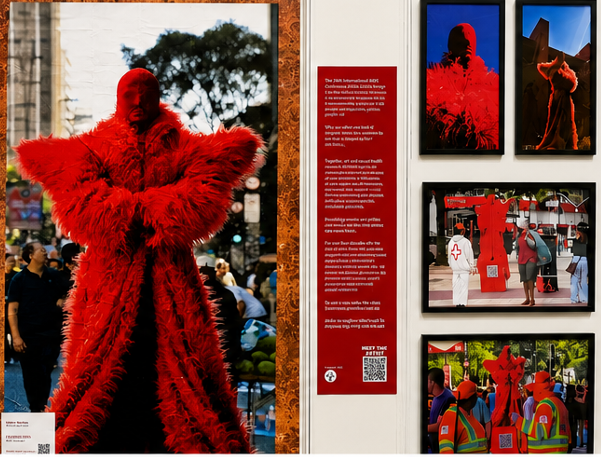
VERMELHO, Red, by Victor Bebiano
What healing actually means
In a geodesic dome nearby, films play through headsets. One of those films is Ubugeni Bwomora or art that heals. It follows Agape Ishimwe, a young Rwandan artist and mental health activist, as he sets up an art therapy project for young people living with HIV in Karongi. It is mostly a film about self-acceptance: adolescents who gradually open up with art as the medium.
I caught up with Agape later in the week. He was born with HIV in 1999, and the project comes directly out of what the system around him did not do. He grew up inside what he calls the NGO system, went through the clubs and the counselling, but continued to live in silence and shame. It was his therapist who handed him the method he now uses on other people: draw whatever is in your mind, then we talk about it.
What he was fighting, he says, was “internalised stigma, one hundred per cent. You pull yourself away from society because you feel like you don’t deserve to be there.”
There is a difference, he explained, between being virally suppressed and being healed. The first is a lab result. The second is not, and one does not deliver the other. The latter is the gap the art is working in. His first cohort was ten young people, kept deliberately small so each could be followed properly. He is raising money for a second, and the timing could not be worse. The project was mid-transition when the cuts happened. “We came at the wrong time, because that’s when almost everything closed.”
Who gets heard
HIV affects some groups disproportionately, and the people most affected are often the least likely to be in the room when decisions are made. Doris Macharia, President of the Elizabeth Glaser Pediatric AIDS Foundation, put numbers to it. Children are 3% of everyone living with HIV and 10% of everyone who dies of it. The reason is not scientific. “The science is not the problem,” she said. “It’s systems.” Community health workers and the mentor mothers who kept women linked to care after delivery were among the first things cut.
Ismail Harerimana knows what that looks like firsthand. He grew up in the foundation’s psychosocial clubs in Uganda and now mentors 173 children at a regional referral hospital. He has not been paid since the cuts and continues the work anyway. The adolescent peer supporter program he helped build has been scrapped. I asked him who speaks for adolescents and children at the meetings where priorities get set. No one, he said.
A few aisles away, adolescents were making the case themselves. Human Touch, a youth organization from Goa, had built a wall called ART THAT SPEAKS about the daily grind of taking medication as a teenager.
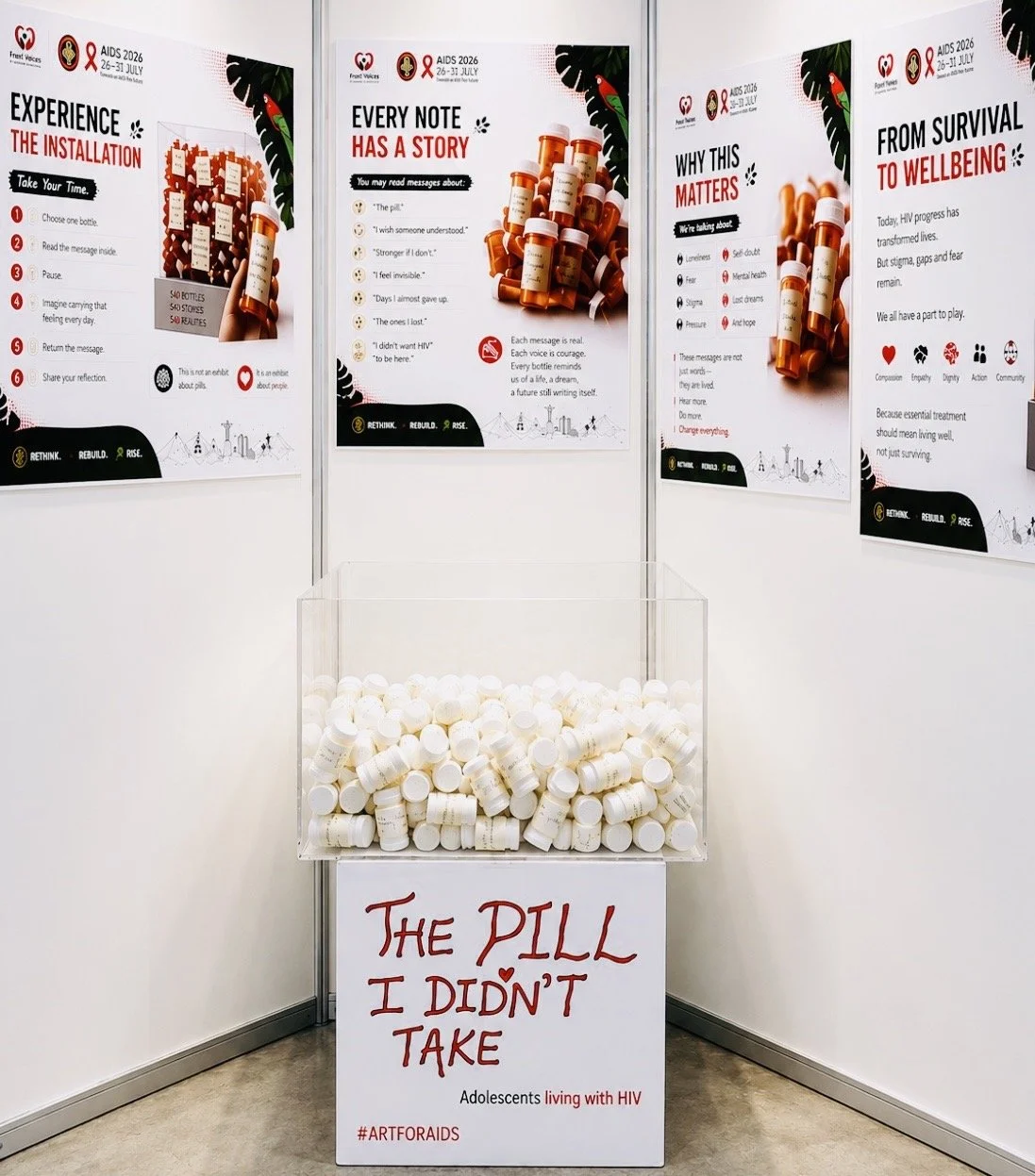
The Pill I Didn't Take by Human Touch
Women are more than half of the people affected but their voices are not heard in proportion. I spoke to the International Community of Women Living with HIV, the only global network by and for women living with HIV, which is one of three organizations behind the People Living with HIV Stigma Index, alongside GNP+ and UNAIDS. That work, they say, has given them a particular expertise in how women living with HIV and their networks are marginalized within the HIV response.
In the film dome, HIV Fell in Love With Me puts pleasure, eroticism and the sexual rights of women living with HIV front and center. The film is by Mariana Iácono, co-directed with Juan De La Mar. Mariana is an Argentine activist who applied to a Visual AIDS call because she knew that nothing explicit existed on sex and pleasure among women with HIV. “It is much harder to talk about women’s sexuality than to talk about death or activism,” she told me.
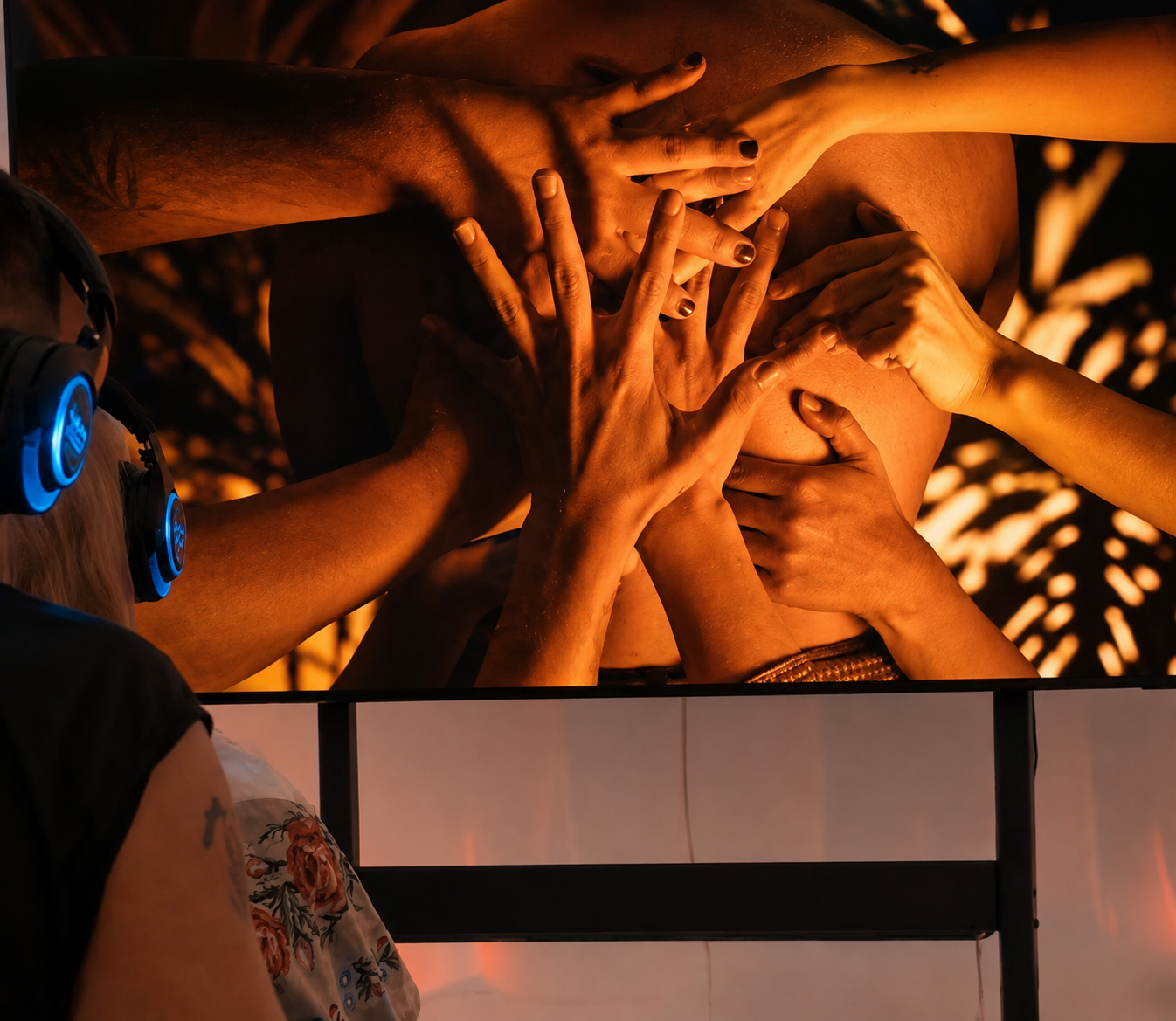
HIV Fell in Love With Me — El VIH se enamoró de mí by Mariana Iácono and Juan De La Mar, screening in the film dome
This is also why ten years of U=U is worth celebrating. Where treatment brings the viral load down to undetectable, the virus cannot be passed on, including sexually. The Prevention Access Campaign launched U=U on that basis in 2016, and in 2025 it opened U=U University, a free training program to equip health workers and community leaders to explain the evidence. Nine years after the science was settled, the campaign is still having to teach it.
Mariana made the same point to me. The message has travelled furthest through LGBTQ+ communities, where the campaigning has been strongest, and more slowly beyond them. This matters for women, since most infections among women happen within long-term heterosexual relationships.
What art does that a press release cannot
If the science is settled and the belief is not, then the remaining work is not more evidence; it is better communication.
Some of the best answers to that were in the Global Village. At HIV Unwrapped, designers were paired with scientists. “When I look at these garments, I don’t see just fabric, I see stories of human life,” said Brent Allan, the Australian activist who founded the project. The show launched in Melbourne in 2024 and has since gained traction outside the HIV+ community spheres, gracing runways in the UK, Rwanda and New York Fashion Week.
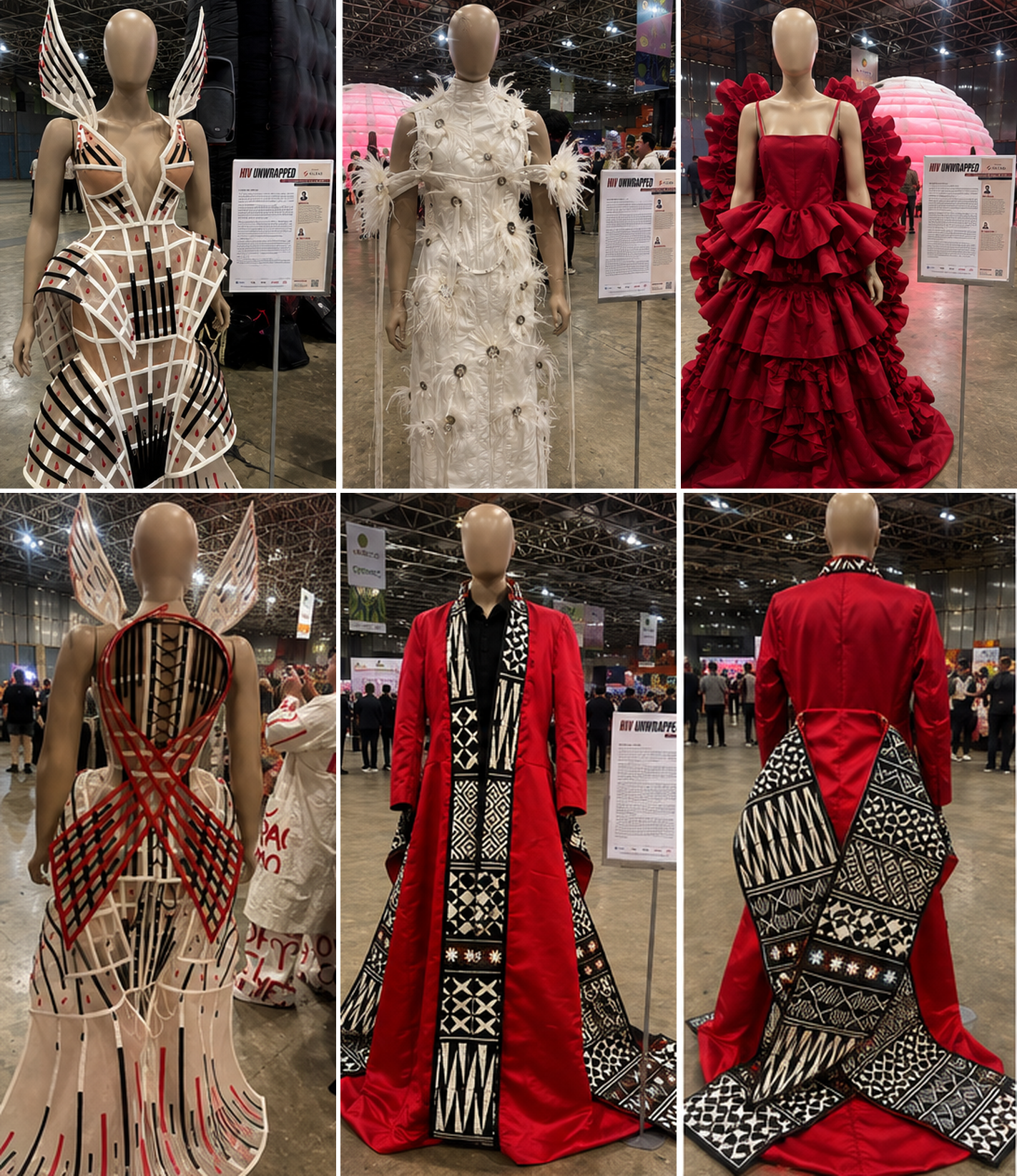
HIV Unwrapped, Brent Allan, some red and white designs from the collection
On the last evening, as the village came down, activists painted red came past in single file, headed for the main stage. They held signs in Spanish and Portuguese: “+arte! –estigma.” “ONGs, no somos competencia, somos aliados” — NGOs, we are not competition, we are allies. “El arte rompe estigma” — art breaks stigma. And “não existe ativismo sem arte” — there is no activism without art.
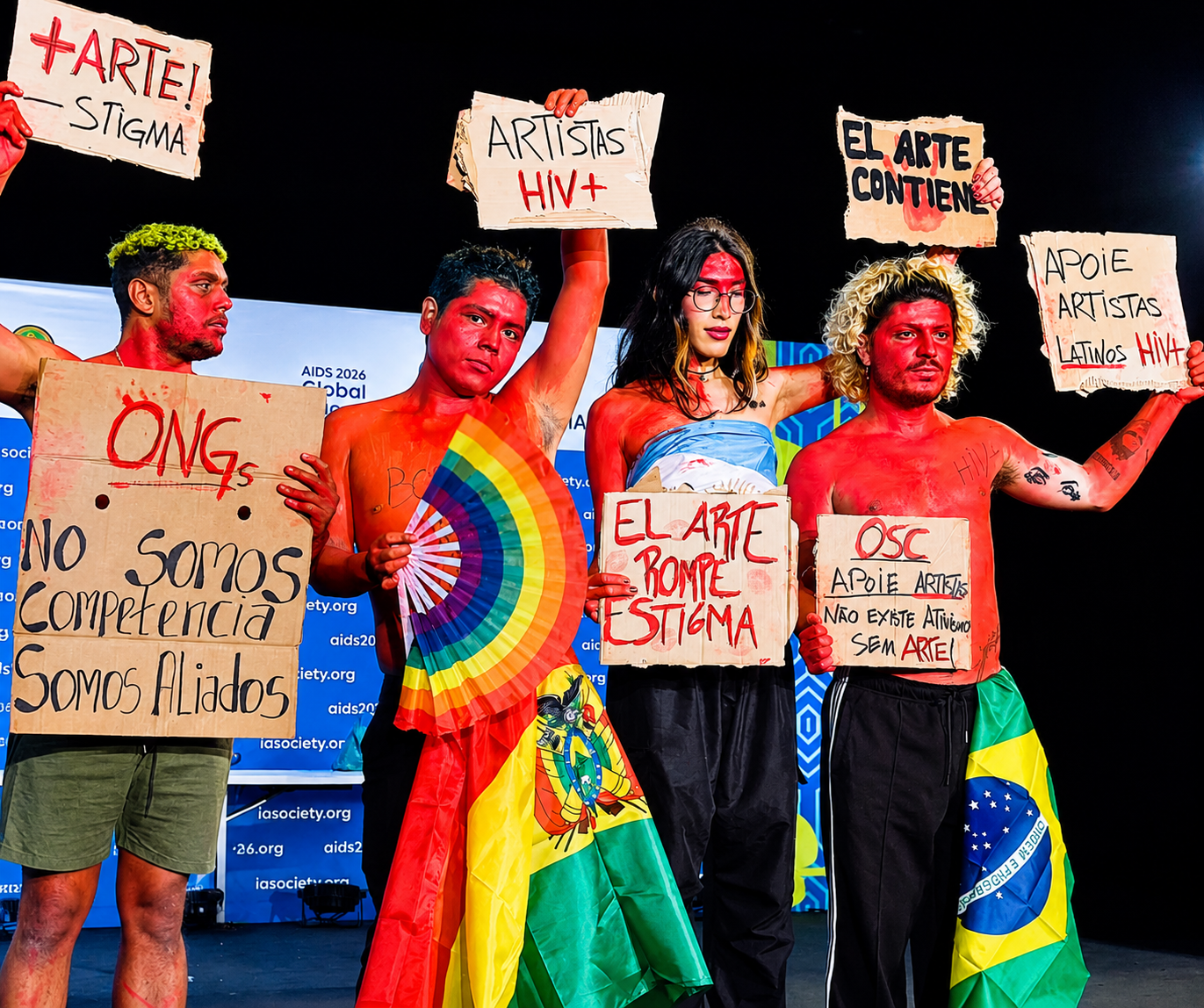
Artists living with HIV in the Global Village on the final evening
Art is not a sideshow around the serious business happening elsewhere. It is the part of the response that reaches people who will never read a global AIDS update. In a year when the money has gone, visibility is the resource the movement still controls.
The cure already exists
The rapporteurs, summing up on the final afternoon, said “communities are moving from resilience to resistance.” Community leadership, they argued, is “the mechanism through which services become accessible, trusted and sustained,” and “activism must always remain at the core of the HIV movement.”
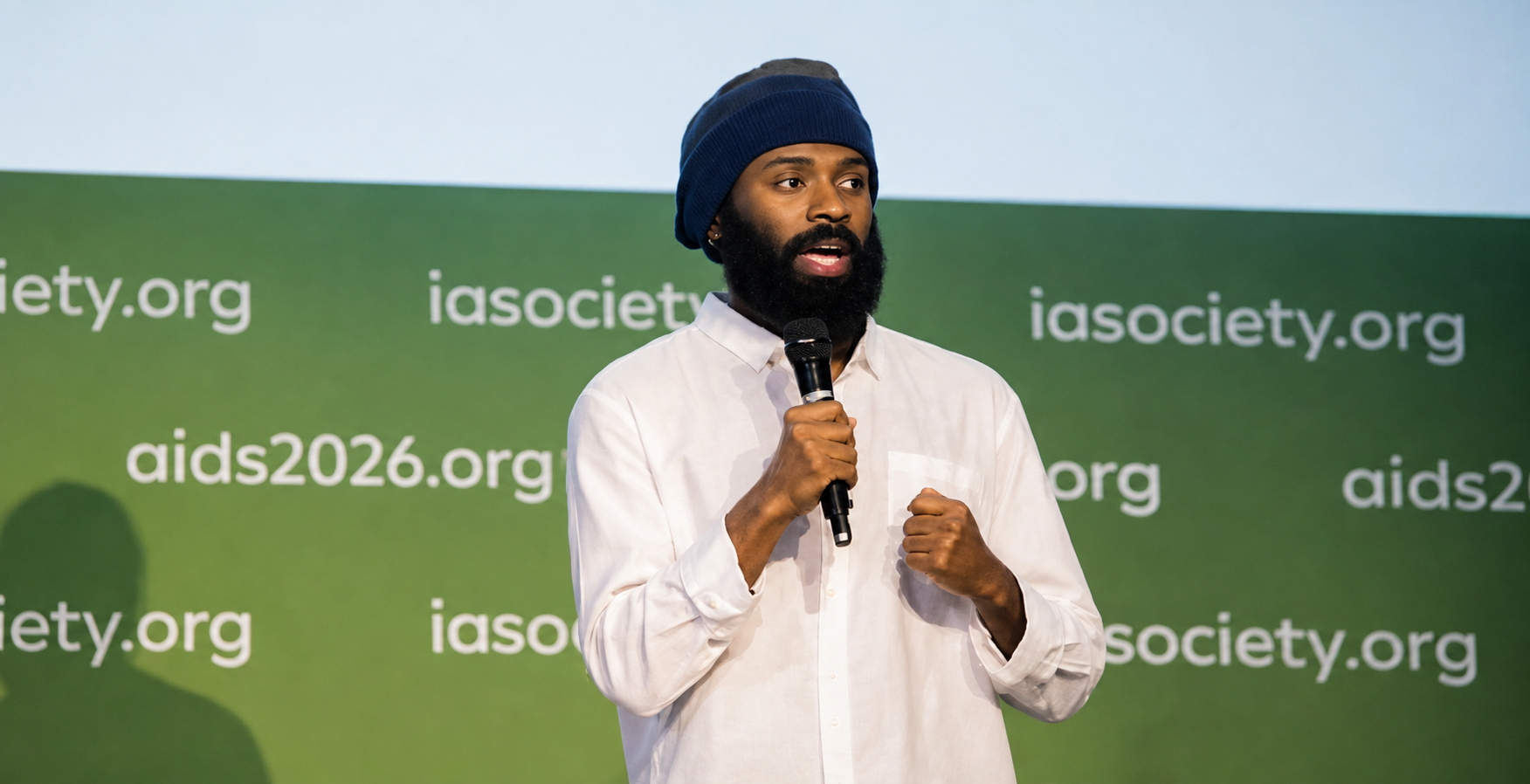
Jean Vinicius Oliveira, Activist, Brazilian Interdisciplinary AIDS Association
Jean Vinicius Oliveira, a researcher and activist with the Brazilian Interdisciplinary AIDS Association then took to the stage. Speaking in Portuguese, he cried out “it this vibrant activism that gives us the courage to fight the logic of the market placed above life, and to ensure that prevention, treatment and new technologies are global public goods.” Let us keep our heads high, he said, “honoring those who came before us and building a future based on justice.”
And then Oliveira closed, to cheers: “The cure already exists, and it is called solidarity.”